
Why a Sixty Foot House Ventilates Differently Than a Short One
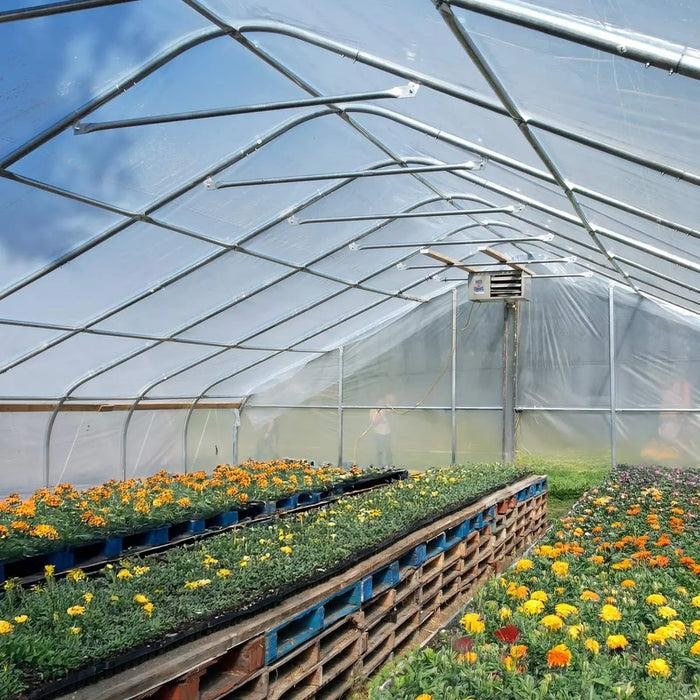
Growers scaling up from backyard structures tend to assume a long house is a short house repeated. The frames and film are the same parts, yet almost everything about running the structure changes once it gets long.
A commercial tunnel greenhouse at sixty feet moves air along its length rather than across its width, and that single difference drives ventilation, crop uniformity and where the structure takes load. A commercial greenhouse is a different machine from a hobby one.
Length Changes the Air Path
Air entering one end gable picks up heat and moisture over every foot it travels. By the far end it is warmer and more humid than where it started, producing a measurable growth gradient from one end to the other.
Two end openings work on a twenty foot structure because the path is short, and a commercial greenhouse is rarely that short. Over sixty feet those openings cannot move enough volume, so side roll-up walls or circulation fans become the method rather than an extra.
Natural ventilation depends on wind and stops working on the still, hot days that cause the damage. Exhaust fans sized to the house volume put a floor under that, and most operations end up running both.
Where the Load Lands on a Long Hoop
In a commercial greenhouse the interior hoops are braced by their neighbors on both sides. The end walls have neighbors on one side only, which is why they carry disproportionate wind load and why end bracing is the detail that fails first in a storm.
A ridge purlin and side purlins turn a row of independent hoops into one structure that shares load. Without them each hoop resists wind alone, and a long house racks lengthwise like a cardboard box pushed from one corner.
Film Choice Over a Long Span
Four decisions matter more at this length.
- Use one continuous sheet where the width allows
- Tension film in cool morning temperatures
- Bury or batten edges, never just staple
- Check wiggle wire channels each season
Greenhouse plastic carries a rated life in years of UV exposure, and that rating assumes it stays tensioned. A loose sheet flaps, abrades at every hoop contact point and fails years early, so retensioning is the cheapest maintenance on a structure this size.
Doors, Ends and Daily Work
A house that a wheelbarrow fits through but a small tractor does not will absorb labor every day of the season. Door width is decided once and paid for continuously, and it is the specification growers most often regret.
Bed layout follows the air path rather than the other way around. A central walkway aligned with the ventilation gives both access and the clearest route for moving air, which is why a polytunnel this long is laid out lengthwise.
Where Commercial Growing Structures Are Heading
Automated vent and fan controllers tied to one thermostat have dropped in price to where a high tunnel greenhouse can justify one, which removes the manual roll-up step that gets missed on exactly the days it matters most.
The thing to settle before ordering a commercial greenhouse is how air will move end to end, because length makes that the limiting question. TMG Industrial gives span, hoop spacing and film specification together, so it can be answered on paper.