
The Hidden Cost of Feed Conversion Ratio Drift in Large Feedlots
A pen that gets sick loses money in a way everyone notices. Treatment costs show up on a bill, a pull rate shows up on a report, and someone asks about it that same week. A pen with feed conversion ratio quietly getting worse loses money in a way almost nobody notices, because it never announces itself. It just costs a little more than it should have, closeout after closeout, until someone finally runs the numbers and finds a problem that’s been sitting there for months.
That’s drift. Not a crisis. A slow leak.
What Counts as Drift, and What Doesn’t
Feed conversion ratio, pounds of feed per pound of gain, is the number that ties most directly to what a pen actually costs to run. A well-managed finishing pen typically lands at 6 or a little better; the wider industry average sits closer to 6 to 6.5; backgrounding operations working heavier on forage usually run above 7. Those are ranges, not a pass-fail line, and a pen a few tenths outside them isn’t automatically a problem.
Drift is different from a bad pen. A bad pen has a cause you can point to: an illness outbreak, a ration mixing error, a water outage. Drift is a pen that never has one clear incident, just a number that’s a little worse this closeout than last closeout, and a little worse than that the closeout before, with nobody able to name the day it started.
Where Drift Actually Comes From
Three sources account for most of it, and none of them look dramatic while they’re happening.
Subclinical acidosis is the quiet one. It happens when rumen pH stays depressed for hours at a time without ever crossing into the kind of acute episode that gets a vet called. The animal eats less, converts what it does eat less efficiently, and shows nothing a pen rider would flag on a normal walk-through. Cattle feeding literature has long noted that by the time acute acidosis shows up as a visible, treatable event, a subclinical version of the same problem was usually sitting in that pen for a month or two beforehand, going unrecognized the entire time.
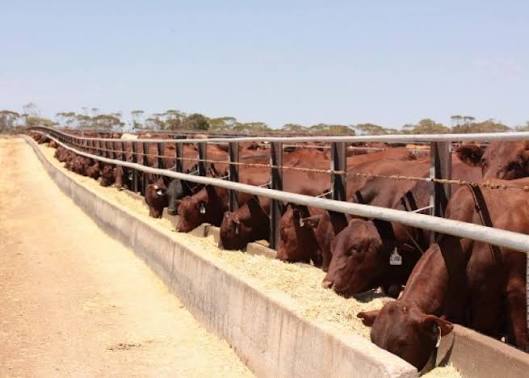
Bunk space and pen dynamics are the second. Cattle establish a dominance order at the bunk the same way they do everywhere else, and dominant animals eat first and eat more. Pens running under roughly 12 inches of bunk space per head see measurably worse outcomes, gains running 3 to 7 percent lower and feed conversion running 5 to 10 percent worse than pens with adequate space, because subordinate animals are consistently getting less feed and picking through whatever’s been sorted and left behind by the time they get a turn. Nobody put a bad ration in that pen. The bunk itself is the problem, and it’s invisible on a feed ticket.
Weather is the third, and the most predictable one that still gets missed. Intake drops during a heat event or a cold snap, cattle partially recover once conditions ease, and the ration doesn’t always get adjusted at the pace the animals actually need. A few days of mismatch between what’s being delivered and what the pen can physically consume adds up over a feeding period, even though no single day looks alarming enough to act on.
The Math Nobody Runs Until Closeout
Half a point of FCR sounds small enough to shrug off. It isn’t.
On a ration running $380 a ton, the difference between a pen converting at 6.0 and one converting at 6.5 works out to roughly $9.50 in extra feed cost for every hundred pounds of gain. Carry that across a 600-pound finishing gain and it’s about $57 more per head. Across a 200-head pen, that’s over $11,000 in feed cost that never shows up as a single bad decision, just a slightly worse number that got compounded across an entire pen for an entire feeding period. Feed already accounts for somewhere between 55 and 70 percent of total cost of gain on most operations, so a drift this size in feed efficiency alone is enough to turn a marginal pen into a losing one.
None of that money disappeared in one obvious place. It leaked out a little at a time, in exactly the way that’s easiest for a monthly reporting cycle to miss.
Catching Drift While There’s Still Time to Fix It
The reason drift survives as long as it does is timing. Most yards check pen performance against projections at scheduled weigh days or at closeout, both of which arrive well after a pattern has already cost money. By the time the number confirms something is off, there’s no version of that feeding period left to fix.
Feed-intake models built on historical pen data and current weather conditions close that gap by predicting what a pen should be eating and flagging when actual intake starts diverging from it, often catching a shift a full one to three days before it would otherwise surface on a scheduled weigh. That’s enough lead time for a nutritionist to check a ration, walk a bunk for sorting, or confirm water access before a two-day dip turns into three weeks of quietly worse conversion. Getting there depends on the intake, weight, and treatment data actually landing somewhere connected rather than scattered across a feed truck log, a scale sheet, and a spreadsheet that only gets reconciled once a month. That’s the specific gap feedlot management software is built to close, tying bunk calls, pen weights, and health events into one place a nutritionist can actually watch in real time instead of after the fact.
What Drift Looks Like Before Anyone Names It
A handful of patterns tend to show up in a yard carrying this problem, usually for a while before anyone connects them:
- FCR creeping a tenth of a point worse every few closeouts, with no single pen or incident anyone can blame
- The same one or two pens consistently a little behind projection, never quite bad enough to investigate on their own
- Bunk calls made off yesterday’s leftover feed rather than today’s actual intake trend
- Ration adjustments that only happen after a scheduled weigh confirms a problem, never before
Any one of these on its own is easy to explain away. Together, they’re usually the same underlying issue wearing different faces.
The Limit: A Model Flags Drift, It Doesn’t Fix the Bunk
Worth saying plainly: none of this replaces a person walking a bunk. A predictive model can flag that a pen’s intake has diverged from what the weather and history say it should be. It can’t tell you whether that’s sorting, a water line issue, heat stress, or the early edge of subclinical acidosis, and it shouldn’t be trusted to guess. Someone still has to go look.
There’s also a data floor underneath all of this. A yard running on paper tickets and a whiteboard doesn’t get a working prediction model by installing software; the model needs a real history of intake and weather data to know what normal looks like for that yard, that ration, that time of year. Smaller operations without RFID and automated scales in place will get less out of this category of tool than a large multi-pen finishing operation will, at least until that infrastructure exists.
Drift That Starts Before the Cattle Arrive
Some of what shows up as FCR drift at the feedlot was decided months earlier, on the cow-calf side. Feed efficiency has a real genetic component, and calves from dams and sires selected with any attention to that trait convert more consistently once they hit a finishing ration than calves with no efficiency data behind them at all.
The practical problem is that most incoming cattle arrive at a feedlot as an unknown. Whatever growth and efficiency history exists for that calf, if it exists at all, is usually sitting in a breeder’s paper records rather than anywhere a buyer or a feedlot nutritionist can see it. Operations tracking calving, weaning weight, and growth performance through cow-calf software are building exactly the record that would let a feedlot know what it’s actually buying, instead of finding out three months into the feeding period that a particular pen was always going to run a little worse than the rest.
Closing the Gap Between a Slightly Worse Number and a Real Problem
Drift is dangerous precisely because it never crosses a threshold dramatic enough to trigger a response on its own. Nobody calls an emergency meeting over a tenth of a point. The cost only becomes visible once it’s been compounding, unwatched, for an entire feeding period, at which point there’s nothing left to do about that specific pen except learn from it.
Cattlytics is built around closing that specific gap, connecting feedlot performance data with cow-calf history so the small, unglamorous shifts that add up to real money get caught while a pen is still on feed, not after it’s already shipped. A slow leak is still a leak. It just takes longer for anyone to notice unless something is actually watching for it.