
Evolution of Sports Broadcasting: From TV to Mobile OTT
The Twilight of the Analog Colosseum
For the better part of a century, the consumption of live sports was a monolithic experience, dictated by the physical constraints of the cathode-ray tube and the scheduling whims of major broadcast networks. The living room served as a secular sanctuary where families and communities would gather at appointed hours, synchronized by the linear transmission of a signal. This era, characterized by passivity and collective physical presence, established a specific cultural rhythm. The viewer was a recipient, tethered to a location and a timeline not of their choosing. If the Super Bowl started at 6 PM, you were on the couch at 5:55 PM. The technology allowed for no deviation, creating a shared but rigid experience that defined sports fandom for generations.
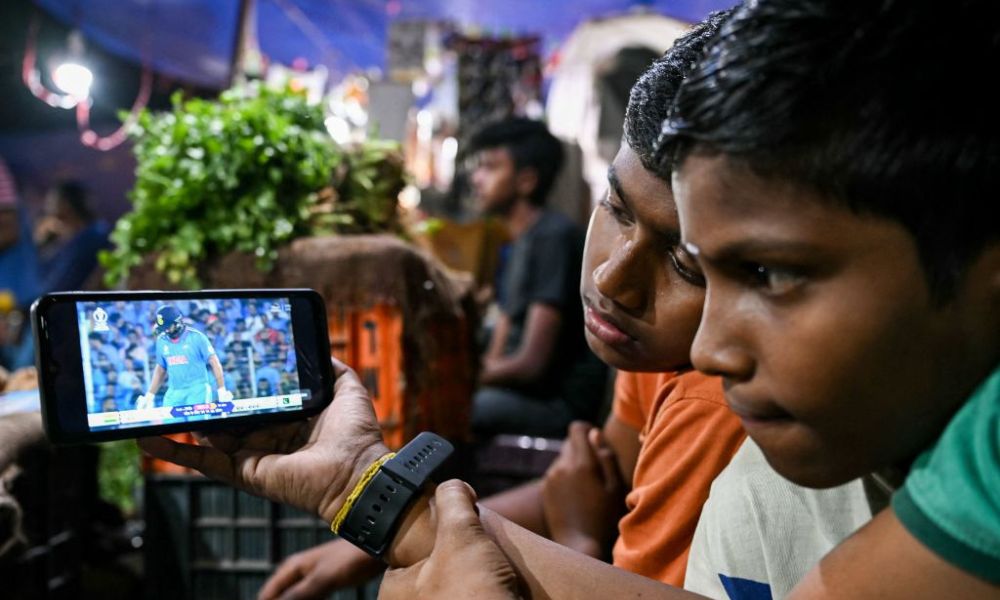
However, we are currently navigating the twilight of this analog colosseum. The rigid structures of appointment viewing are dissolving, replaced by a fluid, on-demand ecosystem driven by mobile technology and high-speed connectivity. This transition is not merely a change in hardware—swapping a 60-inch screen for a 6-inch one—but a fundamental restructuring of the relationship between the spectator and the spectacle. The stadium has effectively been decentralized, atomized, and distributed into the pockets of billions of users worldwide. We are witnessing the death of the “viewer” and the birth of the “user,” a distinction that carries profound implications for the economics, technology, and culture of sports.
The Mechanics of the Cord-Cutting Revolution
The catalyst for this seismic shift is the convergence of high-speed mobile networks (5G) and the maturation of Over-The-Top (OTT) streaming platforms. For decades, cable and satellite providers maintained a lucrative stranglehold on live sports rights, using them as the anchor to sell expensive, bloated channel bundles. This model relied on the exclusivity of access; if you wanted to watch the game, you had to pay the gatekeeper. However, the rise of digital-native platforms has shattered this monopoly, offering a direct-to-consumer model that prioritizes flexibility and cost-efficiency.
This phenomenon, known as “cord-cutting,” is driven by a consumer base that values accessibility over fidelity. The modern fan, particularly the digital native, refuses to be tethered to a coaxial cable. They demand the ability to consume content during a commute, at a workplace, or in a park. This democratization of access has led to a surge in demand for alternative platforms. For instance, baseball enthusiasts, who faced some of the most restrictive regional blackout rules in the cable era, are now turning to mobile-first solutions. The ability to access 무료 야구 중계 (free baseball broadcasting) directly through a smartphone represents a liberation from the legacy infrastructure. It signifies a market correction where the value proposition has shifted from “highest resolution” to “highest availability.” This accessibility is not just a convenience; it is the new baseline expectation for the sports media economy.
The Psychology of the Second Screen
As the medium shifts from TV to mobile, the psychological engagement of the fan transforms alongside it. The television era was defined by a “lean-back” experience—passive consumption where the broadcaster controlled the narrative, the camera angles, and the statistics. The mobile OTT era is defined by a “lean-in” experience. The smartphone is not just a viewing device; it is an interactive portal. We have entered the age of the “second screen,” which is rapidly becoming the primary screen for many demographics.
In this new paradigm, the video feed is merely one component of a multi-layered interface. Fans are no longer satisfied with just watching the play; they want to analyze it simultaneously. Social media integration, real-time fantasy sports tracking, and live betting odds are overlaid directly onto or alongside the video stream. The viewer is actively curating their experience, engaging in global conversations on Twitter while watching a local match. This fragmentation of attention is actually an expansion of engagement. The device allows the user to be the director of their own broadcast, choosing between tactical camera views, player-isolated cams, or traditional broadcast feeds. This level of agency was impossible in the linear TV era and is the key differentiator of mobile OTT.
Latency: The Invisible Technological Battleground
However, the migration to internet-based broadcasting is not without its significant technical hurdles. The most critical of these is latency—the delay between the live action occurring in the stadium and it appearing on the user’s screen. in the analog days, radio and satellite signals traveled at the speed of light with negligible processing delay. In the early days of streaming, however, the process of encoding, packaging, distributing via Content Delivery Networks (CDNs), and decoding could introduce delays of 30 to 60 seconds.
In an era of hyper-connectivity, this latency is unacceptable. A thirty-second delay means a fan might receive a push notification about a goal, or see a spoiler on social media, long before the ball hits the net on their stream. This ruins the emotional climax of live sports. Consequently, the industry is engaged in a technological arms race to achieve “low-latency” streaming. Advanced protocols like WebRTC and CMAF (Common Media Application Format) are being deployed to bring streaming latency down to sub-second levels, rivaling traditional broadcast standards.
This is particularly crucial for platforms that cater to the most avid fans. Users who seek out 무료실시간스포츠중계 (free real-time sports broadcasting) are often doing so because they require the immediacy that legacy streaming often lacks. Whether for live betting, where second-by-second updates are financial necessities, or simply to avoid the spoilers of the group chat, the demand for “real-time” is driving massive infrastructure investment. The winners in the OTT space will not necessarily be those with the most content, but those who can deliver that content the fastest.
Data Integration and the AI Director
Beyond speed, the mobile form factor offers an unprecedented opportunity for data integration. Artificial Intelligence (AI) and Computer Vision are revolutionizing how sports are visualized on small screens. Traditional broadcasters rely on a production truck with human directors making split-second decisions. Mobile OTT platforms are beginning to utilize AI to automate this process, creating personalized highlight reels in real-time or automatically cropping a horizontal broadcast into a vertical format for mobile optimization without losing the focal point of the action.
Furthermore, the overlay of advanced analytics—known as “augmented video”—is becoming standard. Viewers can click on a player during a live stream to see their current sprint speed, heart rate, or historical shooting percentage. This turns the broadcast into a rich data visualization tool. For the fantasy sports generation, this depth of information is addictive. It transforms the match from a simple narrative into a complex, solvable puzzle. The screen is no longer a window; it is a dashboard.
The Immersive Horizon: VR, AR, and Spatial Computing
If mobile OTT represents the current apex of accessibility, the next frontier is immersion. We are standing on the precipice of the “Spatial Computing” era, where the boundaries between the digital and physical worlds will blur entirely. Virtual Reality (VR) and Augmented Reality (AR) are poised to disrupt the mobile paradigm just as mobile disrupted TV.
The limitations of the smartphone—its small, two-dimensional screen—will eventually be overcome by headsets and glasses that offer an “infinite canvas.” Imagine sitting in your living room but perceiving yourself to be in a courtside seat at the NBA Finals. VR broadcasting allows for this telepresence, solving the scarcity problem of physical tickets. You can look left and right, hear the spatial audio of the crowd, and feel the scale of the arena. AR, conversely, will bring the data of the mobile screen into the real world, projecting stats and replays onto your glasses as you watch a game at a pub or even in the stadium itself.
While these technologies are still in their infancy compared to the ubiquity of smartphones, the trajectory is clear. The evolution of sports broadcasting is a history of removing friction and reducing distance. TV removed the need to travel to the stadium. Mobile OTT removed the need to be in a living room. VR will remove the screen itself. We are moving toward a future where the consumption of sports is a seamless blend of the real and the virtual, personalized to the exact desires of the individual user. The device in our pocket is just the current vessel for this journey, a bridge to a world where we don’t just watch the game, but inhabit it.